
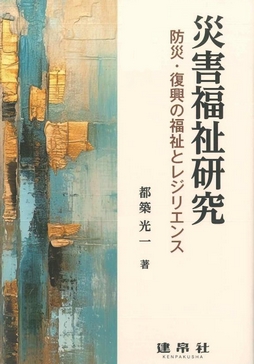






成熟した民主主義国家においては,社会福祉政策が充実するはずである。人間の尊厳に基づく個人を尊重する考え方に支えられることによって,社会福祉の充実が促されるはずだからである。しかし「できているはず」の社会福祉政策も,予想もしない突然の出来事で,矛盾点が露わになることがある。その重要な一つのインシデントが災害である。……(中略)……災害福祉対策を考えることは,私たちの社会の未熟な点や矛盾点を改善していくための取り組みにほかならないのである。……(中略)……福祉支援の取組みを強化すべきとの議論もあるものの,回復力の「レジリエンス」としての議論は災害福祉としてはそれほど多くなされているわけではなく,未だ道半ばである。そこで本書は,レジリエンスの展開を基本とする災害福祉についてまとめてみた。(はじめにp1)
本書は,三部構成でまとめている。第一部は理論編で、災害と福祉について議論するに当たって鍵概念となるレジリエンスについて,様々な用語・定義および先行研究などを整理した。第二部は実践編で,具体的な災害時の支援活動を取り上げ,専門職の必要性や理論編で述べたレジリエンスに通じる実践のあり方に触れているほか,現行の法制度についても解説した。第三部は人材養成と今後の課題について述べている。人材養成に関しては,養成すべき人材の代表例として災害派遣福祉チームの養成研修を取り上げ,基礎研修とスキルアップ研修の二段階のものを例示した。全体として社会福祉分野以外の方でも理解していただけるよう,事例や新聞記事などを織り込んでいる。
その中でも特に強調した点は,災害対応は社会の仕組みで行うべきであるという点である。近年の日本では,災害に見舞われる毎に,災害対応の不備が指摘されることが少なくない。そこで我々が取り組まなければならない社会のあり方に関する課題について,本書において指摘したのは「「個人の尊厳にもとづく自立支援」を実践し,いかなる震災に見舞われようとも揺らぐことのない,地域住民の主体的な協働の仕組みの構築を目指す必要があるという点である。この構築に向けた取組みの,具体的な検証の積み重ねが求められていると思われる。(p328)」
災害は,国際防災機関の定義によれば,外力によって社会に著しい被害を及ぼし,社会が自力で対処する能力をこえるものを言う。これを回復させていくためには,外部からの支援を受けることができるようレジリエンスを高め,新たな日常を構築していく必要があり,そのための世界に通じる対応力(capacity)の形成が必要となる。今求められている視点は,確かに必要な支援を速やかに展開することは無論であるが,それとともに「災害福祉対策」を社会の仕組みとするための取組みであることを述べている。
Disaster
Welfare Studies
Published by Kenpakusha, July 2025
Koichi Tsuzuki
In mature
democratic countries, social welfare policies are expected to be well developed.
as they should be promoted by supporting the principle of respecting
individuals based on human dignity. However, these policies that should be
working can reveal contradictions when faced with unexpected, sudden
events, one of the most significant being disasters. ...(omitted)... A thorough
consideration of disaster welfare measures is nothing other than addressing the
immaturities and contradictions in our society in order to promote its
betterment. ...(omitted)... While some argue that welfare support initiatives
should be further strengthened, discussions on resilience as a part of
recovery essential to disaster welfare remain limited and are still in progress.
This book, therefore, seeks to provide a summary of disaster welfare based on
the development of resilience. (Introduction, p.1)
This book
summarizes the need to establish, as part of the social framework, support
activities centered on welfare assistance for disaster victims, which have so
far received little attention. This is because past large-scale disasters have
revealed both insufficient support for disaster victims and highly
inappropriate support provided to those who actually required welfare support. Based
on these facts, this book discusses, from the perspective of social welfare,
the need to strengthen resilience in order to establish a social framework that
ensures the provision of welfare support during disasters, while aiming to
realize a new normal with such resilience. All disaster victims, unexpectedly
and unwillingly becoming victims, suddenly find themselves in such situations,
facing a crisis despite having done nothing wrong. To overcome these
circumstances, disaster victims must contend with the overwhelming stress and
grief of losing loved ones and property, while incurring significant expenses
that require extensive time and effort. In doing so, they bear substantial
emotional and physical burdens, as well as the responsibility for rebuilding
their lives, often over a prolonged period. Although Japan's social framework
more than 230 years ago was capable of addressing such issues, why the
responsibility for rebuilding victims' lives today falls on individuals remains
a question that warrants vigorous discussion in preparation for future
disasters.
This book is
organized into three sections. The first, the theoretical section, reviews
various terms and definitions, as well as previous research on resilience, which
is a key concept for discussing disaster and welfare. The second, the practical
section, examines specific support activities during disasters, addressing the
role of professionals and practical approaches aligned with the concept of
resilience discussed in the theoretical section, and also provides an overview
of the current legal framework. The third section discusses human resource
development and future challenges. With regard to human resource development,
the book uses the training of disaster welfare assistance teams as a
representative example, illustrating a two-stage program consisting of basic
training and advanced skill-development training. Overall, the book is written
in a manner that allows readers outside the field of social welfare to
understand, incorporating actual cases and newspaper articles.
In the entire
book, the point of particular emphasis is that disaster response should be
carried out within the framework of society. In recent years in Japan,
shortcomings in disaster response are often pointed out after each disaster. Regarding
the challenges we must address in shaping society, the book emphasizes the need
to establish a framework for proactive collaboration among community members,
practicing self-reliance based on individual dignity, so that it remains
resilient in the face of any disaster. It seems that concrete evaluations of
efforts toward establishing this framework (p.328) should be conducted
repeatedly.A disaster,
according to the definition by an international organization for disaster risk reduction,
is an event caused by external forces that results in significant harm to
society and exceeds the ability of society to cope on its own. Recovering from it
requires strengthening resilience to accept external support, creating a new
normal, and developing capacities for this purpose that are recognized
internationally. It goes without saying that the current perspective should involve
promptly providing all necessary support, but it should also emphasize efforts
to integrate disaster welfare measures into the social framework.